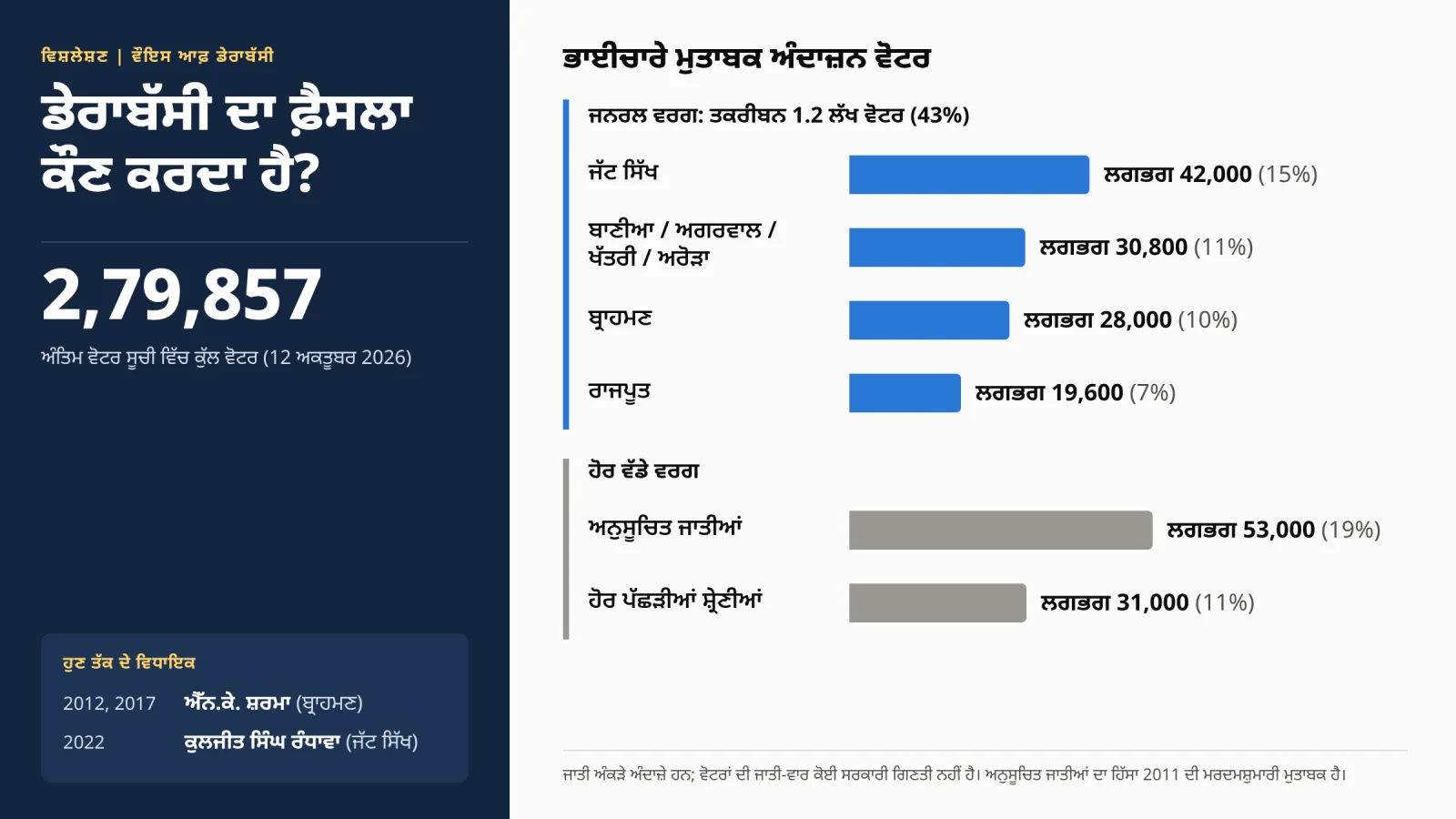
Dera Bassi is one of the largest assembly seats in Punjab. The final voter list, published on 12 October 2026, has 2,79,857 names. With the election only months away, one question is heard in every market and village: which communities decide the result here?
First, a word on the data. Nobody has an official caste-wise count of voters. The voter list does not record caste, and the 2011 Census counted only the Scheduled Castes, who were 19% of this halka. Every other figure, including ours, is an estimate.
Going by working estimates, four general-category groups stand out:
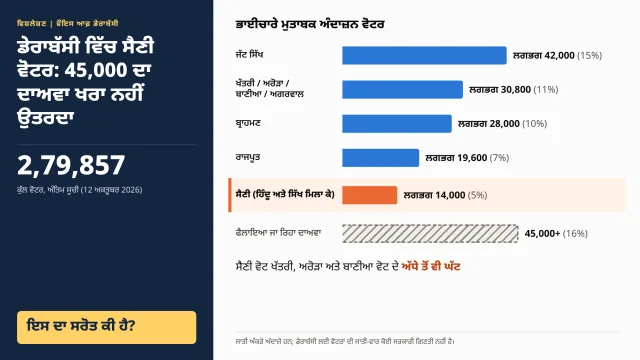
Jat Sikh: about 42,000 voters (15%)
Baniya, Aggarwal, Khatri and Arora: about 30,800 (11%)
Brahmin: about 28,000 (10%)
Rajput: about 19,600 (7%)
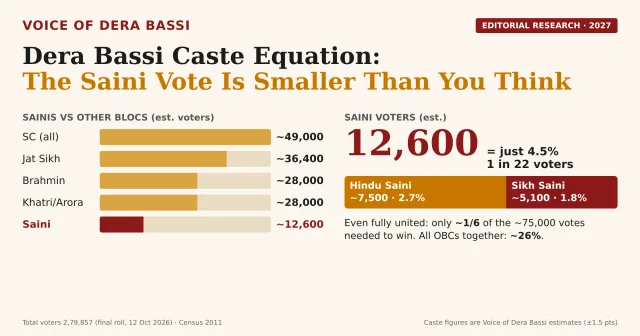
Together they come to roughly 1.2 lakh voters, about 43% of the roll. No other block is close. Scheduled Castes are about 53,000 voters, and the other backward classes together about 31,000.
Geography adds to their weight. More than half the halka lives in its towns, led by Zirakpur, Dera Bassi and Lalru, where trading and service families are largely settled. In the villages, farming families carry the most influence. A winning candidate needs both, and these communities are present in both.
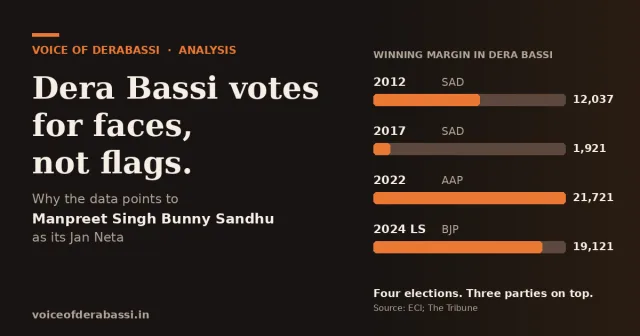
The record of MLAs tells the same story. The seat has voted three times since it was formed. N.K. Sharma of the Shiromani Akali Dal, a Brahmin, won in 2012 and 2017. Kuljit Singh Randhawa of the Aam Aadmi Party, a Jat Sikh, won in 2022. So far, nobody from outside these two communities has won Dera Bassi.
Still, 43% is not a majority. Winners here have taken between 35% and 45% of the votes, and in 2017 the margin was only 1,921. No community can win alone. Scheduled Caste, backward class and migrant voters can tilt a close contest.
One caution. Large claims are sometimes made about the strength of a single Saini community, even 45,000 votes or more. Before believing or forwarding such a number, ask a simple question: what is the source?
Caste arithmetic can explain who gets a ticket. It cannot fully explain who wins. The communities that have shaped this seat still hold the strongest hand, but the final decision belongs to every voter.