Voice of Dera Bassi Desk | November 7, 2026
For thousands of young people across Punjab, the Punjab Civil Services (PCS) Mains result was a moment they had waited six years for. The last Mains was held in 2020. When the Punjab Public Service Commission (PPSC) finally declared the result on November 4, it shortlisted 751 candidates for interviews against 331 posts. Within a day, the list had turned into a political fight.
What the aspirants are saying
A group of candidates studied the shortlist roll number by roll number. Their claims, shared with the media and in a memorandum to the President, the Prime Minister, the Chief Minister and the CBI, are:
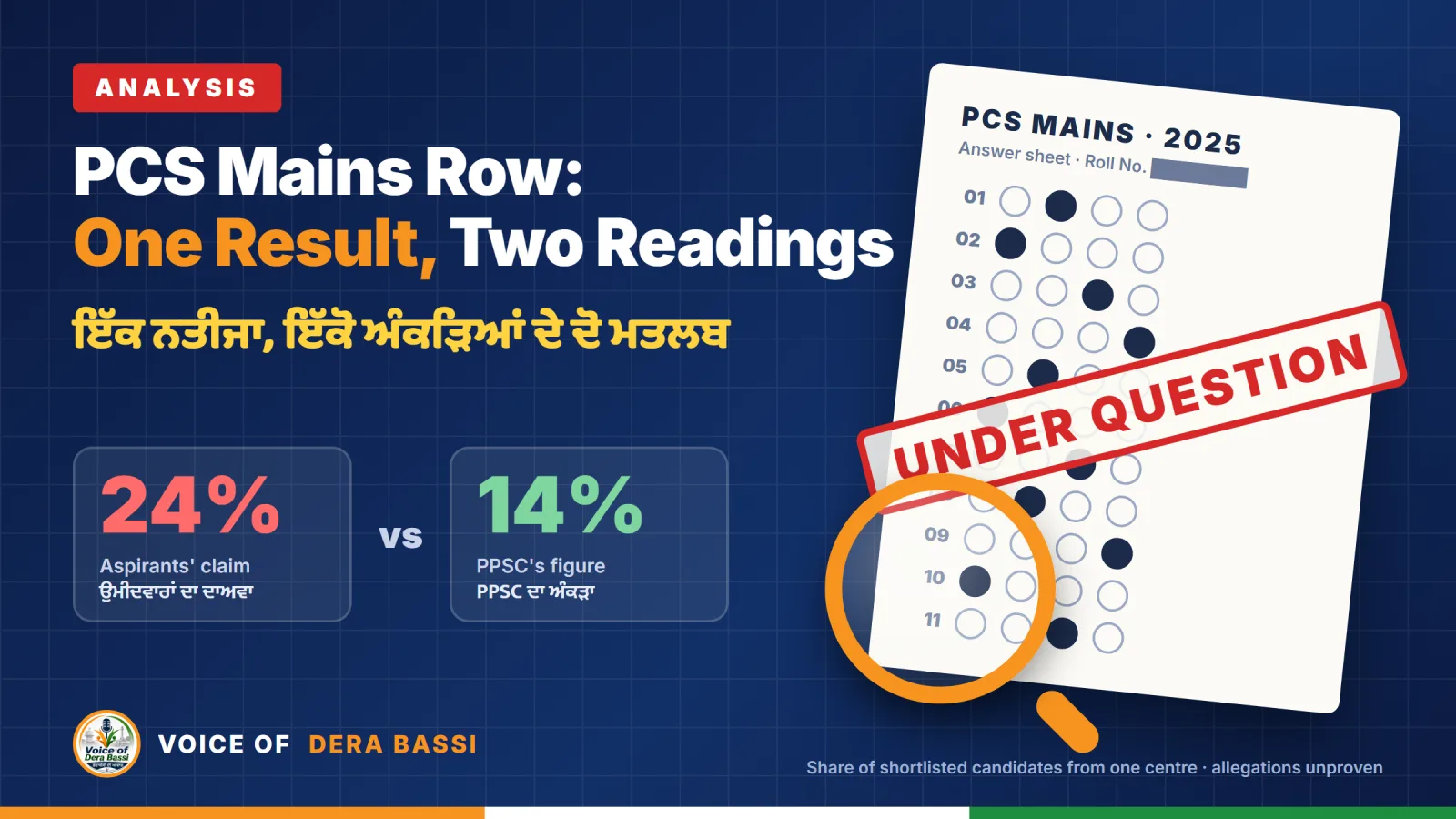
About 24 per cent of shortlisted candidates came from one centre, listed as “Centre-8”. Neighbouring centres were at around 3 per cent.
In some exam rooms, 10 or 11 of roughly 24 candidates cleared.
86 shortlisted candidates appeared in 26 groups of consecutive roll numbers.
Some roll numbers of candidates who did not sit the exam were on the list.
What the PPSC says
At a press conference in Patiala on November 6, PPSC Chairman Maj Gen Vinayak Saini (retd) said these claims come from a misreading of the data. His figures were:
The highest number shortlisted from any one centre was 106 of 751, about 14 per cent. That centre had 496 candidates, the second largest of 12.
Only three of 179 classrooms had 10 or more qualifiers. The average was about four per room.
Earlier exams showed similar patterns. In 2018 and 2020, eight or nine qualifiers came from single classrooms, and there were 26 and 28 groups of consecutive roll numbers.
No absent candidate was shortlisted. Biometric and manual attendance were taken, and CCTV and jammers were used at every centre.
He also said no political figure had put pressure on him during his tenure.
The political response
The opposition has closed ranks on this issue. BJP spokesperson Pradeep Bhandari accused the AAP government of protecting a “paper leak mafia”. Former state BJP chief Sunil Jakhar called the exam “hijacked”. State BJP president Kewal Singh Dhillon described the PPSC’s defence as a “self-clean chit”. Congress leader Pargat Singh has sought an independent probe, and SAD’s Bikram Majithia has said he will move the High Court. The BJP’s leaders are pressing for a CBI inquiry.
The AAP government has not announced any probe so far.
Reading between the lines
The core of the dispute is a simple question: is a cluster of good results in one place a sign of wrongdoing, or just chance? Both are possible. Big centres produce more qualifiers. Coaching hubs can push results up in nearby rooms. On the other hand, consecutive roll numbers and room-wise clustering are exactly the patterns investigators look for in exam fraud.
Neither side has yet put the full data in public. The aspirants’ analysis has not been independently checked. The PPSC’s rebuttal, however detailed, is the commission examining its own exam. That is the gap an independent audit could fill.
Two numbers also don’t match. Aspirants say 24 per cent; the PPSC says 14 per cent. The difference may come from how “one centre” is defined, whether one building or several rooms. Only the raw data can settle it.
What to watch
Document verification is scheduled for November 11 to 17. If interviews begin while the dispute is open, the matter is likely to reach court.
Whether the PPSC publishes centre-wise and room-wise data on its own.
Any petition in the Punjab and Haryana High Court, and what it orders.
For the candidates, the stakes are not political. Many have spent the best years of their twenties on this one exam. Whatever the truth, they deserve a process they can believe in, and the quickest route to that is transparency.
Note: The claims of irregularity and paper leak are allegations made by candidates and political leaders. They have not been proven, and the PPSC denies them.