Voice of Dera Bassi Editorial Desk | November 2026
Quick take: The Dera Bassi caste equation points to a simple truth for the 2027 Punjab Assembly election. The BJP is strong in Zirakpur and the towns but weak in the villages. To win, it needs a candidate who can carry both. On the numbers available today, Manpreet Singh Bunny Sandhu, a Jat Sikh leader from the halqa, fits that role better than most.
Dera Bassi Voters in 2026: A Seat of Two Halves
Dera Bassi has changed beyond recognition in ten years. In 2012 it had about 1.79 lakh voters. The final roll published on October 12, 2026, after the Special Intensive Revision (SIR), lists 2,79,857 voters, the most of any seat in Mohali district.
Roughly half of them live in Zirakpur. The rest are spread across Dera Bassi town, Lalru, Bhankharpur and about 140 villages along the Ghaggar. So there are really two electorates here: a fast-growing city of apartments and markets, and an older belt of farming villages. A party that speaks to only one of them will struggle.
Dera Bassi Caste Equation: The Community Profile
India’s census records religion and Scheduled Castes, but no other castes, so part of this picture is estimated, and we label it that way.
Official (Census 2011, Dera Bassi tehsil): about 61% Hindu, 34% Sikh and 19% Scheduled Castes. Migration into Zirakpur has very likely raised the Hindu share since then.
Estimated share of today’s electorate, from a constituency caste profile built on census, Election Commission and IndiaStat data:
Voter bloc Estimated share Main groups
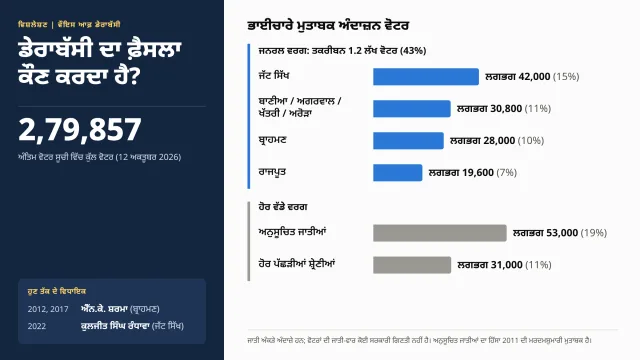
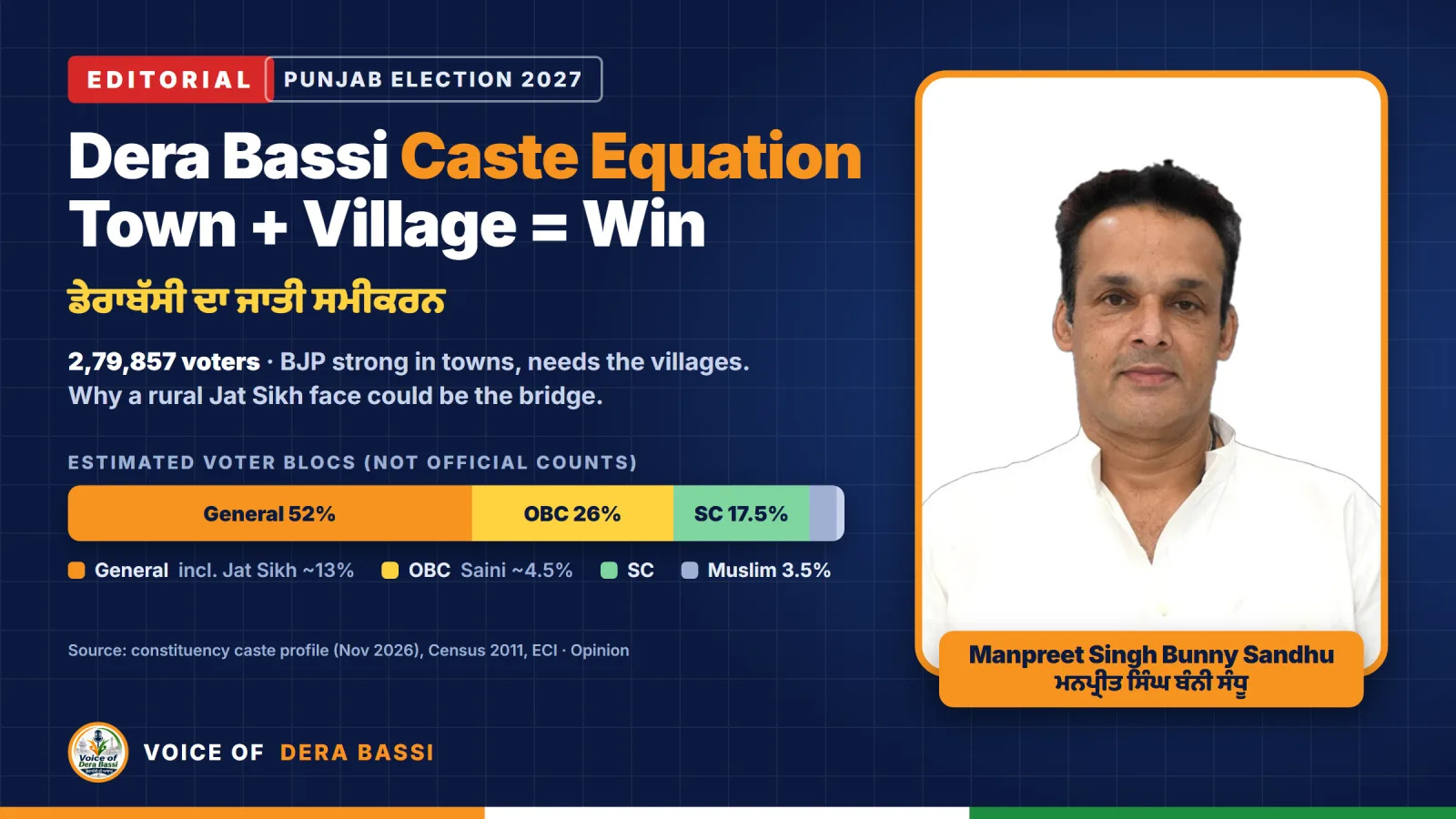
General castes ~52% Jat Sikh (~13%), Brahmin (~10%), Khatri-Arora (~10%), Rajput (~6%), Bania (~6%)
OBCs ~26% Saini, Vishwakarma/Ramgarhia, Kashyap, Gujjar, Purvanchali migrants
Scheduled Castes ~17.5% Mostly Ravidasia/Ramdasia and Balmiki
Muslims ~3.5%
These are estimates, not counts. Still, they show clearly where the votes are.
What the 2022 and 2024 Results Reveal About the BJP
Put the last two elections side by side and the BJP’s challenge jumps out.
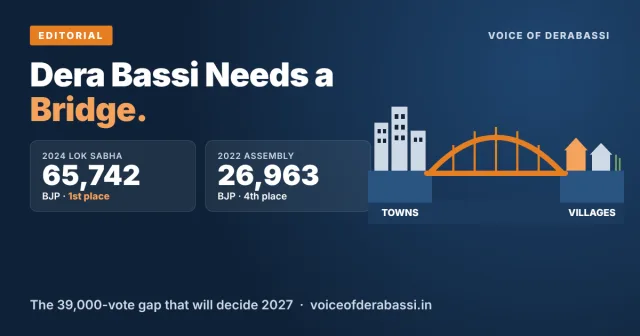
2022 Assembly election: AAP’s Kuljit Singh Randhawa won with 35.1% and a margin of 21,721 votes. Congress got 24.2%, the SAD 23.9% and the BJP just 13.5%.
2024 Lok Sabha election (Dera Bassi segment): the BJP led with 65,742 votes, ahead of Congress (46,621) and the SAD (33,748).
Reporting at the time put the BJP’s 2024 lead down to the urban Hindu vote, migrant workers in the industrial belt and Preneet Kaur’s personal standing. Farmer anger kept much of the rural vote away.
The lesson is plain. The BJP has a base in the towns and a gap in the villages.
The Winning Number in a Four-Way Contest
With AAP, Congress, the BJP and the SAD all in the fight, around 75,000 votes (about 27%) could be enough to win Dera Bassi in 2027.
The BJP’s urban vote can take it a long way towards that figure, but probably not the whole way. The rest has to come from the villages. That is where, by most local accounts, the Jat Sikh vote (around 13%) and the rural SC vote (around 12% of the electorate) went largely to AAP last time.
Why the Candidate Decides Dera Bassi
Towns tend to vote for a party. Villages tend to vote for a person they know: someone who turns up at the gurdwara, the panchayat and the family wedding.
That is why the choice of candidate matters more in Dera Bassi than the party’s general popularity. A Jat Sikh face from the area gives the BJP three things an urban candidate cannot:
A way into the villages. A trusted local leader can reach farming families that have kept away from the BJP since the farm-law protests. Because the 2022 margin was only about 7–8% of today’s roll, even a small swing here changes the result.
An answer to the “city party” tag. Rivals will say the BJP belongs to Zirakpur’s towers, not Dera Bassi’s fields. A Sikh candidate with rural roots is the simplest reply.
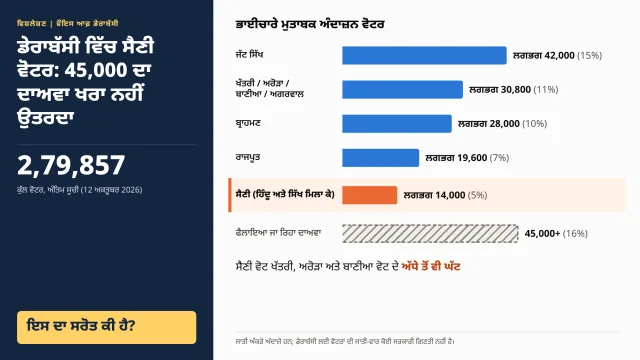
A fit with the OBC outreach. Haryana Chief Minister Nayab Singh Saini has been reaching out to Punjab’s OBCs, with sammelans in Ropar and Abohar in 2026, and reports have linked this effort to Zirakpur and Dera Bassi. Sainis (an estimated 12,000 to 13,000 voters here) and Purvanchali migrants are thought to lean BJP. A Jat Sikh candidate working alongside an OBC campaign covers both groups in the same villages.
Why Manpreet Singh Bunny Sandhu Is the BJP’s Best Bet
Manpreet Singh Bunny Sandhu ticks the boxes this seat demands.
Local and rural roots. He is a Jat Sikh leader from the Dera Bassi halqa, with ties in the Puadh villages.
Farm-sector experience. As a former vice-chairman of Punjab Agro Industries Corporation, he has worked directly with farmers and agri-business, the very voters the BJP most needs to win back.
Party standing. He is a BJP spokesperson and already active in the party’s local work.
Visible on the ground. In April 2026, Rajya Sabha MP Satnam Singh Sandhu asked him to find land for a women’s skill training centre in Dera Bassi. That kind of practical, local work is what villages remember.
Above all, he can talk to both halves of the seat: about roads, traffic and civic services in Zirakpur, and about land, crops and trust in the villages. The BJP is not short of votes in the city. What it lacks is a bridge to the countryside. Bunny Sandhu can be that bridge.
The Risks the BJP Cannot Ignore
A fair editorial has to name the risks too.
Caste alone does not win. Jat Sikhs are about 13% of voters, not a majority.
Farmer resentment is real. One ticket will not erase it. It has to be earned village by village.
The SIR has trimmed the roll by about 6%. We do not yet know whose names were removed, and that could hurt any party’s base.
The SC villages need real attention. In places like Jarout, Samgauli and Hamayunpur, 40% or more of residents are Scheduled Castes. They will want commitments on jobs, housing and services, not symbolism.
Conclusion: Reading Dera Bassi’s Arithmetic Right
The candidate who wins Dera Bassi in 2027 will be the one who builds the widest coalition: Zirakpur’s urban voters, the OBC belt, the SC villages and the Jat Sikh heartland.
Read the Dera Bassi caste equation this way and the picture is clear: on current numbers, the BJP starts with the first two. A rural Jat Sikh candidate like Manpreet Singh Bunny Sandhu gives it its best shot at the other two. The ticket is the party’s call, but the arithmetic is hard to argue with.
Frequently Asked Questions
How many voters does Dera Bassi have in 2026?
The final electoral roll published on October 12, 2026, after the Special Intensive Revision, lists 2,79,857 voters, the highest in Mohali district.
What is the caste equation of Dera Bassi?
Estimates put general castes at about 52% (including Jat Sikhs at ~13%), OBCs at about 26%, Scheduled Castes at about 17.5% and Muslims at about 3.5%. Only the SC and religion figures come from the census; the rest are estimates.
Who won Dera Bassi in the 2022 Punjab election?
AAP’s Kuljit Singh Randhawa won with 35.1% of the vote and a margin of 21,721 votes.
How did the BJP do in Dera Bassi in 2024?
In the 2024 Lok Sabha election, the BJP led the Dera Bassi assembly segment with 65,742 votes, ahead of Congress and the SAD.
Why is Manpreet Singh Bunny Sandhu seen as a strong BJP option for Dera Bassi?
He is a local Jat Sikh leader, a BJP spokesperson and a former vice-chairman of Punjab Agro Industries Corporation. That gives the BJP a credible face in the villages, where it is weakest, to add to its strong urban base.
Note: Caste and community figures are estimates from a constituency caste profile (revised November 6, 2026) built on Census 2011, Election Commission and IndiaStat data. They are not official counts. Election results are from the Election Commission of India. Electorate figures are from The Tribune and Punjab News Express. This is an opinion piece reflecting the views of the Voice of Dera Bassi editorial desk.